Most people booking their first building inspection think they are paying for certainty. What they are actually paying for is a trained set of eyes and an honest opinion, and knowing the difference before you sign is worth more than the report itself. A good inspection tells you where the risk sits and where a specialist is worth the money. It does not hand you a guarantee that the house is perfect, and any report that reads like one should make you more careful, not less.
A pre-purchase inspection is a visual, non-invasive check of a house against the New Zealand standard, NZS 4306:2005. The inspector looks at everything they can safely see and reach: the roof, the exterior, the interior, the subfloor, the wet areas, and the visible parts of the plumbing and electrical. They take moisture readings at the high-risk spots and record the condition of the house on the day. The inspector does not open up walls, lift floors, test appliances, value the property, or replace a specialist. What you get is a written report: the condition of the house, where the real risks are, and what needs a closer look before you buy. It tells you where the problems are likely to be. If the house comes back clean, that is good news, but the report reflects what could be seen and measured on the day, not a full guarantee of what sits behind the walls. A thermal imaging add-on can pick up moisture or missing insulation through a surface, without opening anything up.
What "visual and non-invasive" really means
This is the whole basis of the inspection, so it is worth being plain about. Visual means the inspector assesses what can be seen. Non-invasive means nothing gets dismantled, cut, drilled or lifted to get there. Consumer Protection puts it simply: the standard pre-purchase inspection is a visual inspection, which means it will not identify problems concealed behind finished surfaces like framing, wiring or plumbing.
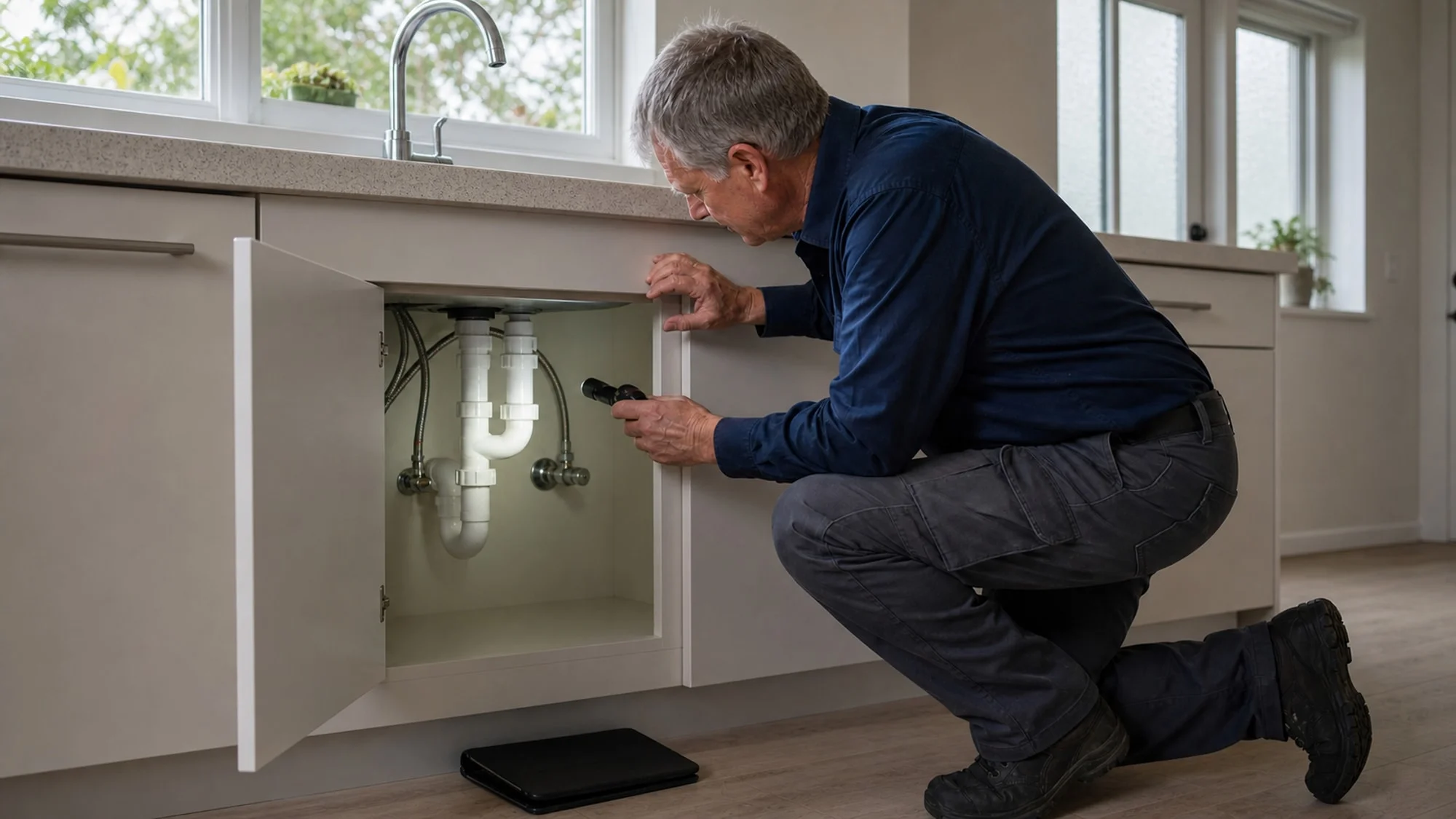
In practice the inspector uses more than eyes. Tapping a surface and listening for a hollow sound, feeling for soft or springy spots, a torch into the dark corners, a ladder for the roof, a moisture meter at the wet areas. It is thorough, it is just not destructive.
The common misunderstanding is that the inspector will pull back the carpet, open a wall or lift the floorboards to check underneath. They will not, and they should not, without the owner's permission and a different, more forensic agreement. That limit is a feature, not a weakness. It keeps the inspection quick, affordable and non-destructive, and a good report is honest about what it could not see rather than pretending it saw everything.
Also called a building report or a builder's report
You will see this same service called a few different things: a pre-purchase house inspection, a building inspection, a building report, or a builder's report. In New Zealand, buyers use these terms interchangeably, and they usually mean the same job. What actually matters is not the label but the substance: the scope of what was checked, the standard it was carried out to, who inspected the property, and whether the report clearly separates the defects it found from the limitations of the inspection and the recommended next steps. A tidy-looking report that blurs those three is worth less than a plain one that keeps them clear.
What a Datum inspection covers
Working to NZS 4306, here is what actually gets looked at on the day.
- The roof. Covering, flashings, gutters, downpipes, chimneys and penetrations, from the safest position that gives a proper view. On some jobs that means going up on it. On others it is done with a drone, which is faster and often gets a better look at ridges, valleys and the awkward junctions. Either way, the roof is part of the standard inspection.
- The exterior and cladding. Walls, windows, doors, decks, steps, balconies, handrails, and the junctions between them. This is where a lot of moisture problems start, so the inspector is reading the condition of the cladding and looking for cracking, staining, movement and poor detailing around windows and joints.
- Windows, doors and joinery. Not just how they look, but whether they work. Do the windows open, close and seal, do the doors sit square, is the cabinetry sound. Sticking or dropped joinery can be cosmetic, or it can be an early sign of movement in the structure.
- The interior. Walls, ceilings and floors, and the linings themselves: the GIB, skirtings, window reveals and architraves. The inspector is looking for cracking, sagging, staining, past patch-ups and any sign that water has been somewhere it should not.
- Wet areas and waterproofing. Bathrooms, kitchens and laundries get particular attention, because they fail quietly. Cracked or poorly sealed tiles, a damaged or flexing shower tray, leaking traps, tired silicone. Small faults that let water into the framing over months and years before anyone notices.
- Ventilation. Whether extractor fans exist and actually work, and whether they vent outside rather than straight into the roof space. A bathroom fan pumping warm, wet air into the ceiling cavity is one of the most common faults we see, and it does slow, hidden damage that a buyer would never think to ask about.
- Moisture readings. Non-invasive moisture meter readings are taken at the high-risk spots: wet rooms, below windows, and external wall junctions. These readings are indicative and surface level. A high reading is a reason to investigate further, not a diagnosis on its own. A low reading is reassuring, but it is not a promise that everything behind the lining is dry.
- The subfloor. Where there is safe access: piles, bearers, joists, ground clearance, subfloor ventilation, and any sign of moisture, borer or rot. This is another spot buyers are tempted to skip because it is awkward to get into. It is often exactly where the useful findings are.
- Services, visually. The visible plumbing, the switchboard and visible wiring, and the hot water cylinder get a visual check. Outdated switchboards, obvious DIY wiring, corroded pipework. This is a visual note only. It is not an electrical or plumbing compliance test.
What it does not cover
The scope is deliberately bounded, and knowing the edges is the point of this article. A standard NZS 4306 inspection does not include:
- Anything hidden. Inside wall cavities, under floor coverings, behind linings, or underground. If it cannot be seen without dismantling something, it is not in scope.
- Invasive investigation. No cutting holes, lifting floorboards, removing cladding or pulling back fixed coverings. That is a separate, more forensic job, and it is often the right next step if the visual inspection turns something up.
- Appliances and whiteware. Ovens, cooktops, dishwashers, rangehoods, heat pumps and the like are not function tested. Testing appliances and certifying the electrical system is the work of a registered electrician or the relevant tradesperson, not a building inspection.
- Full electrical and plumbing testing. The switchboard and visible services are looked at, but a detailed electrical compliance check, drain camera work or gas testing needs the specific trade.
- Structural, geotechnical and engineering assessments. If a crack, a slope or a foundation issue needs a verdict, that is an engineer's call.
- Pools and pool fencing. Pool structures and fence compliance are not part of the inspection.
- Thermal imaging. A thermal camera is not part of the standard scope. Datum offers it as a thermal imaging add-on where it earns its place.
- Council and legal checks. It is not a LIM, a property file review, a Code Compliance Certificate check or a title search. Your solicitor and the council cover those.
- A valuation. An inspection tells you about condition, not about what the property is worth.
- A guarantee about the future. The report describes the condition on the inspection day. It is not a warranty that nothing will go wrong later, and under the standard it is not a statement that the house complies with any Act, regulation or bylaw.
None of this is the inspection falling short. It is the inspection doing its actual job, which is to give you an honest read of what can be seen and to point clearly at where a specialist is worth paying. Often the most useful line in a good report is the one that says "we could not access this" or "get an engineer to look at this before you go unconditional."
The weathertightness question every NZ buyer should ask
If you are buying a home built between the late 1980s and the mid-2000s, weathertightness deserves real attention. The high-risk window most people point to is roughly 1994 to 2004, when a run of monolithic (plaster-style) cladding, flat or low-pitched roofs, minimal eaves, and for part of that period untreated timber framing, combined to cause the leaky-building problem. Settled.govt.nz has a good, straightforward rundown of the era and the design features to watch for.
Here is the honest limit. A visual inspection can flag the risk profile: the cladding type, the era, the design, cracking around windows, staining, a musty smell. What it cannot do is clear a high-risk home as weathertight, because on these houses there is often no visible sign while damage builds behind the lining. The government's own buyer guidance makes the same point. On this cladding type you frequently need a specialist or invasive moisture testing to know for sure.
So the position we take is straightforward. We will tell you if a property sits in the high-risk profile, and exactly what we can and cannot see. If it does, the sensible next step is a targeted weathertightness investigation with moisture testing, which goes beyond the standard visual scope and can include invasive testing where it is allowed. MBIE's guide to diagnosing leaky buildings sets out that same order: non-invasive checks first, then invasive testing if the signs warrant it. Better to know before you go unconditional than to inherit a reclad you did not budget for.
Who writes your report (and why it matters here)
Here is something most buyers do not know. In New Zealand, building inspection is not a regulated occupation. There is no licence you must hold to call yourself a building inspector, and no legal minimum for what a report has to contain. NZS 4306:2005 is the recognised standard, but following it is voluntary.
That puts a lot of weight on who actually does the work. Consumer Protection's own advice is to check the person is qualified, ask whether they carry out a NZS 4306 inspection, and ask to see their indemnity insurance, which protects you if they miss something. It is worth doing all three of any inspector you consider.
Datum's answer on the qualifications part: our inspections are carried out by experienced builders who have moved off the tools and additionally hold Licensed Building Practitioner (LBP) status. LBP is not required to inspect a house, precisely because inspection is not regulated. We hold it anyway, because it means the person reading your roof and your framing has been building to code and is accountable to a recognised competency scheme.
In short, an ex-builder mate doing you a favour is not the same as a qualified inspector following the standard, and the consumer guidance says as much. Pay for the report, and pay attention to who writes it.
A pre-purchase inspection is one of the cheapest steps in the whole buying process and one of the most useful, as long as you understand what it can and cannot do. If you would like a property looked over by qualified builders working to NZS 4306, see our pre-purchase house inspection in Auckland or get in touch. For what is included and the optional add-ons like thermal imaging, see our pricing.
This article is general information, not professional or legal advice. For a specific property, get your own inspection and talk to your solicitor.