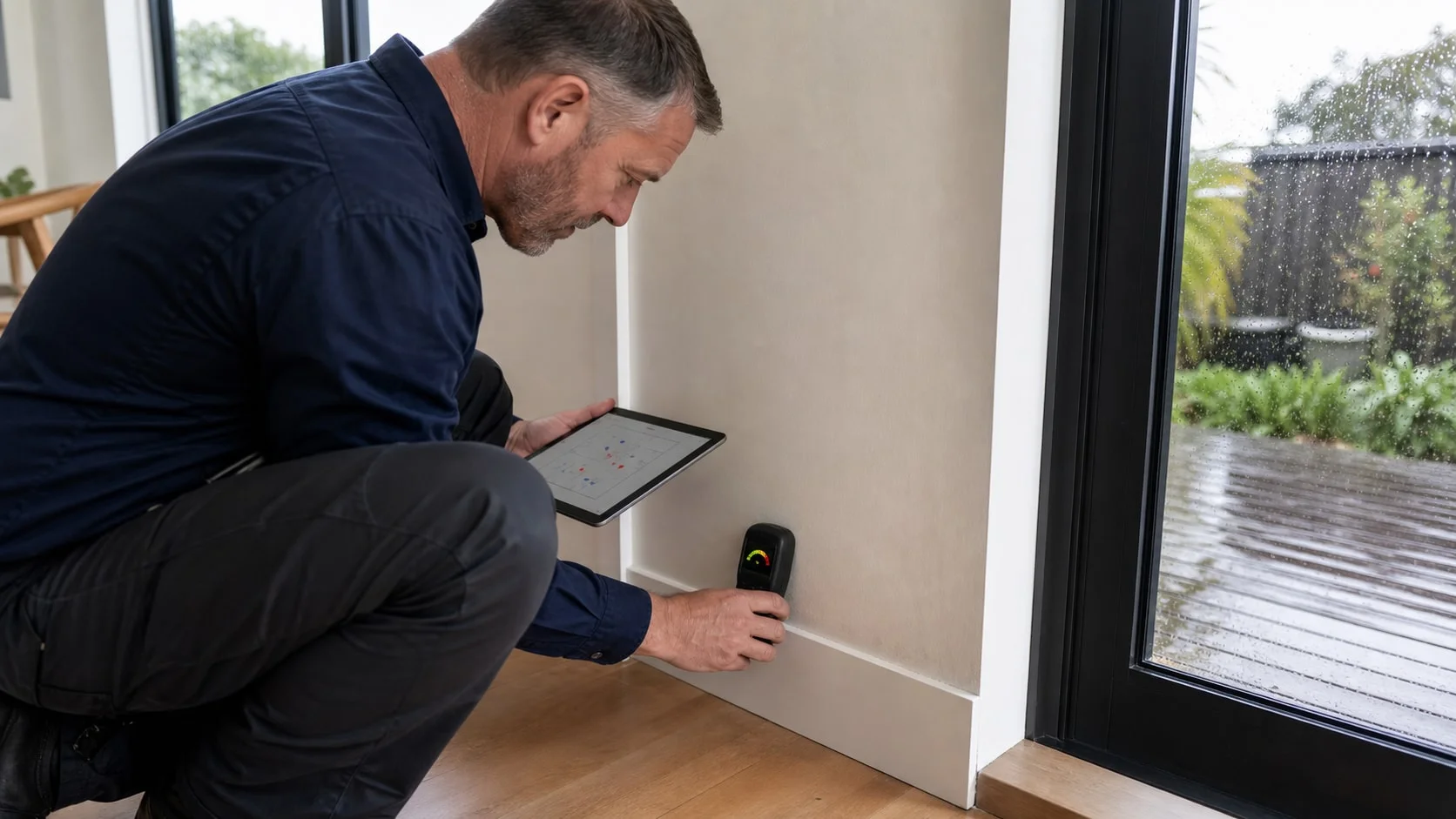
Somewhere in most building reports there is a number attached to a wall, and somewhere in most house purchases there is a buyer staring at that number like a test result. We see it every week: the meter said 23, or 48, or 90, and the question that follows is always the same one. Is that bad? What counts as a high moisture reading in a house in NZ turns out to be a better question than it looks, because the honest answer is that the number on its own tells you almost nothing. What makes it mean something is everything recorded around it.
Here is the short version, then the detail.
There is no single number that makes a moisture reading high, because the two kinds of meter answer different questions. A non-invasive meter reads through the surface without damaging it, and its numbers are comparative: they mean something measured against readings from the same meter, on the same material, elsewhere in the same house. MBIE's guide to diagnosing leaky buildings is blunt about this, describing such readings as indicative rather than a measurement of actual moisture content. A probe meter driven into timber does measure moisture content, and there the bands are known: up to about 18 percent is dry territory, 18 to 24 percent signals a problem that needs correcting, and from the mid twenties onward decay becomes a genuine risk. In practice, high means well above the baseline for the same material in the same house. That is a reason to investigate. It is not, on its own, a diagnosis, and a normal reading is reassurance for that spot on that day, not a certificate.
What the meter is actually measuring
Two different tools get called a moisture meter, and telling them apart is half of reading a report properly.
The first is the non-invasive meter, the flat-backed scanner an inspector holds against a wall. It never touches water at all. It sends a signal through the lining and reads how the material responds, which changes when moisture is present. Nothing is drilled and nothing is damaged, which is why this is the tool that can sweep a whole house, and it is the one behind the moisture readings in a standard building report. The number it shows sits on a scale that varies between brands and settings, which is the detail most buyers are never told. Twenty-three on one meter is not twenty-three on another, and neither is a percentage of anything.
The second is the probe, or resistance, meter: two pins driven into the timber itself, reading the moisture content of the wood as a true percentage. This is the measurement the decay science is built on, and it is far more precise about the timber it touches. It also makes holes, so on a pre-purchase inspection it is not used through someone else's linings without the owner's permission and a separate, more invasive agreement.
The order of use matters as much as the tools. MBIE's diagnosis sequence runs from a visual inspection, to non-invasive readings, and only then to invasive measurement where the readings justify it. The scanner finds the places worth a closer look. The probe establishes what is actually happening there. A report that treats a scanner number as a final measurement has skipped a step, and it is a step that matters.
What counts as a high moisture reading
Start with the measurement that has real thresholds: timber moisture content, from a probe. The bands MBIE's guide sets out are worth knowing, because they are what "too wet" actually means in a New Zealand timber-framed house.
- Up to 18 percent. Within the allowable range for untreated radiata pine framing, and generally considered unable to support timber decay. This is dry territory.
- 18 to 24 percent. A problem. Readings here indicate excess moisture that should be corrected, and mould growth becomes common in wall cavities in this range.
- 24 to 30 percent. Decay can establish, depending on how the timber was treated, and readings here are commonly associated with actual damage.
- Above 30 percent. Free water is present in the timber. In untreated framing, decay at this level is close to inevitable.
Notice what those bands quietly depend on: the treatment of the timber. In a house with treated framing, a wet patch has a margin of forgiveness. In a house framed with the untreated kiln-dried pine that the framing standard permitted from 1995 until 2004, the same moisture content is far more dangerous, because the timber has almost no natural resistance to decay. That overlap is a large part of why the leaky-building era did the damage it did, and our guide to leaky homes in NZ covers that history properly.
The scanner is different. A non-invasive reading has no universal scale, so there is no number we can print here that would mean high in every house, and you should be wary of anyone who quotes one. What high means on a scanner is high relative to the same house: the reading below the window is three times the reading on the same wall a metre away, on the same material, with the same meter. That comparison is the finding. An inspector who takes baseline readings on known dry areas first, then works through the risk spots, is building the context that turns a number into evidence.
On a probe in timber, high is a moisture content heading past 18 percent. On a non-invasive scanner, high is a reading that stands clearly above the baseline for the same material elsewhere in the same house. Any number quoted without its meter, its material and its comparison readings is just a number.
Why context beats the number
The first piece of context is the material. Tile, plasterboard, plaster and timber all read differently, and a wet-area wall with a waterproofing membrane behind it is a different measurement problem from a bedroom wall. A figure that is unremarkable on one surface can be notable on another, which is why the material is recorded with every reading we take.
The second is the day. Auckland spends much of the year humid, showers get used an hour before an inspection, washing gets dried indoors, and winter condensation sits on the inside of cold windows and the walls around them. All of it can lift readings without a drop of water having come through the building envelope. A reading is a snapshot of the day it was taken, in the weather it was taken in, and part of interpreting it is knowing what that day was doing.
The third is comparison, which is the discipline the whole exercise rests on. One reading is a point. A set of readings, taken across the whole house and mapped to where they were taken, is a picture. It is why a proper moisture test records the location, material and context of every reading rather than handing you a list of numbers, and it is why we photograph the spots as we go. The question is never what did the wall read. It is what did this wall read that the others did not.
Patterns, not points
Once the readings are mapped, the shape of them starts to talk. A single elevated point with nothing around it is often innocent, and gets rechecked rather than alarmed over. A cluster of elevated readings fanning out below a window corner is a story: water is getting in at the joinery and spreading. Elevated readings along the bottom of an external wall say something different from a wet patch in the middle of a ceiling, and a trail that gets wetter as it approaches a deck junction is close to an arrow pointing at the failure.
Height matters too. Moisture near the base of a wall can be rising from below, coming down from above, or being made in the room by condensation, and the pattern up the wall helps separate those. This is the part of moisture testing the meter does not do. The meter finds the moisture. Knowing what the pattern usually turns out to mean is the actual craft.
The most common mistake we see is a buyer carrying a single number out of a report and shopping it around: is 30 bad, is 48 high, should this scare me. By the time that number is being quoted over coffee it has left behind the meter that produced it, the material it was read on and the readings around it, which is everything that gave it meaning. If you catch yourself doing this, go back to the report and find the comparison instead. What did the rest of that wall read? If the answer is about the same, you are probably looking at a material or a damp day. If the answer is a fraction of it, now you have a real question.
When a reading is a reason to investigate
When we find an elevated reading, the sequence is deliberate, and it is the same one MBIE's guidance describes: cheapest and least invasive first. The spot gets re-read and the extent mapped. The innocent explanations get checked against the building: was the shower used that morning, is this the cold side of the house in winter, is there a bathroom on the other side of that wall. Then the outside of the building at that exact point gets a hard look, because the cause of an inside reading is very often an outside detail: a cracked sill, tired sealant, a junction with no visible flashing.
If the reading survives all of that, it earns escalation. Thermal imaging can show the extent of moisture across a whole surface rather than at points, without opening anything up. Probe readings can establish true moisture content where access allows it. And where the owner agrees, invasive testing can answer the question inside the wall directly. On a high-risk cladding type, that escalation is not paranoia. It is the method.
If you are mid-purchase, the timing matters more than the tool. An elevated reading flagged in a report is a question to resolve before you go unconditional, while resolving it can still change the price or the decision. Moisture readings at the high-risk spots are already part of what a pre-purchase inspection covers, and when they point at something, a targeted moisture investigation is the natural next step rather than a nice-to-have.
A high reading is a question, not a verdict, and a normal reading is an answer for that spot on that day, not a warranty. The value is not in the number. It is in what gets done about it next.
What a meter cannot tell you
Here is the honest limit, and it applies to every meter on the market, including the ones we carry. A non-invasive meter reads at and just below the surface. It cannot see deep into a sealed cavity, and on thick claddings it may not reach the framing at all, so a clean scan of a thick plaster-style wall is a much weaker assurance than a clean scan of a plasterboard one. Readings can be pushed around by metal behind a lining and by moisture sitting on a surface rather than inside it. And because timber dries out while damage does not, a wall that failed two winters ago can read normal today after a dry spell, with the decay still in it. None of these are our caveats. They are limitations MBIE's diagnosis guidance lists plainly.
So no, we cannot certify a house as dry from surface readings, and neither can anyone else. What a good moisture inspection does is narrower and more useful: it tells you where moisture is showing, how that compares with the rest of the house, what most likely explains it, and exactly what would settle the question. When the readings are clean, it tells you what was tested, on what day, and what that does and does not rule out. Anyone offering more certainty than that off the back of a scanner is overselling the tool.
A moisture meter is a few hundred dollars of electronics, and the reading is the cheap part. What you are actually paying for is the judgement of the person holding it, and an honest account of what this particular number means for this particular house.
A moisture reading is evidence, not a verdict, and it is only as good as the comparison and the judgement around it. If a report has handed you a number and you are not sure what it means for the house, get in touch and we will tell you straight, including when the honest answer is that it is nothing. For a mapped, photographed set of readings across a whole property, see our moisture testing service.
This article is general information, not professional or legal advice. For a specific property, get your own inspection and talk to your solicitor.